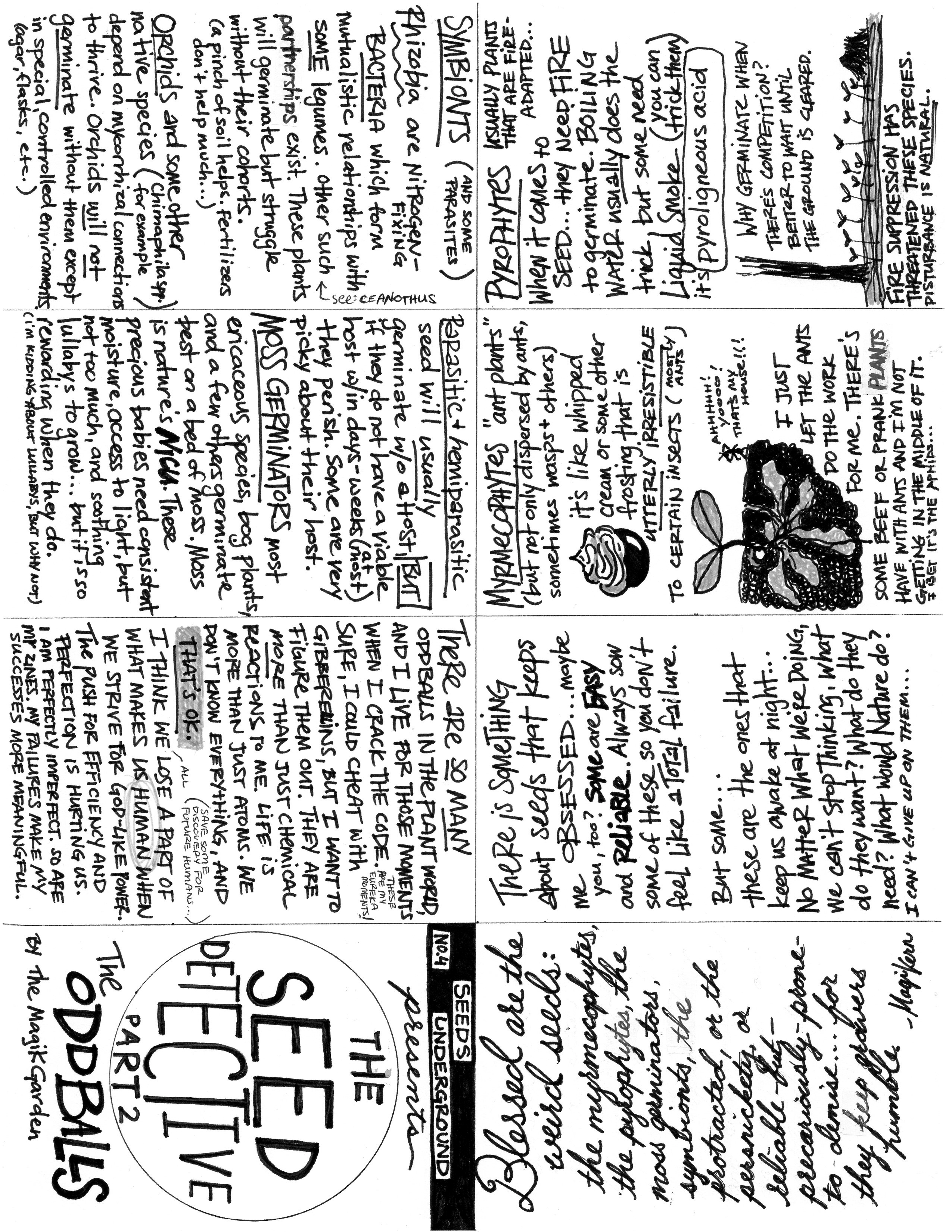
I absolutely love the “oddball seeds.”
These are the ones that aren’t easy to grow. You can’t just winter-sow them in a jug for 60 days and expect they pop up in the first year. While I love all plants, and the easy-to-grow ones certainly simplify my life when it comes to running a nursery, these oddballs are the ones that I secretly obsess over. But for some, even this is too much waiting. It’s too inefficient. We’ve got orders to fill, deadlines to meet, and projects to complete, because the customer demands and competition is fierce… so they cut corners, and grow from cuttings.
As a mother I will repeat the same thing that every mother, including Mother Nature, has said to her child: the best things come to those who wait. I don’t reward impatience. It’s a damn good thing we nipped cloning humans in the bud when we did, because I’m not sure that would’ve happened in today’s society.
The moment I hear that someone struggles with a particular species, I need to figure it out. I try to dig up whatever information I can find about the species (and with some that I’m growing, there isn’t much). I do a lot of research. I ask other growers if they’ve tried it, and what they tried, and what did or didn’t work. And then I come up with a plan and give it my best shot. If it fails – which often it does – I go back to the drawing board, see what I missed. The few times I have given up earlier on, some of those seeds did end up germinating in the garden anyway. As if to tease me with their demand avoidance. We grow on our terms, not yours.
This entire process, reaching out for help or advice, perusing over a stack of real, physical books, experimentation, failures, and then ultimately the success… this is what makes us human. I challenge myself to grow the more difficult species because honestly – the frustration, failure, discomfort with the unknown, waiting and hoping, that’s what it means to be human. We are messy and flawed, and we screw up. We aren’t efficient. Our bodies often fail us, and it’s a miracle we even function sometimes. Sometimes our organs aren’t even in the right place. But then we also adapt, create, and achieve despite ourselves, and we celebrate our successes. We are everything we feel and experience. If our thoughts, ideas, perceptions and experiences can be altered by a non-human entity, what is happening to us? I’ve seen videos popping up of people asking “why is everyone starting to look the same with the same uncanny valley stares?” We are becoming clones of a selected, developed, patented ideal.
If all we ever grow are clones, is that really helping the ecosystem? I’m not just talking about cultivars, but let’s clear that up first. I view cultivars as “gateway plants” for people who are trying to get out of the mindset of traditional horticulture and step into the world of native gardening. They’re developed to be easy to grow in a garden setting. Most, as of this writing, do provide at least some value to habitat, and far more value than exotic species. As someone who has first-hand experience in trying to bridge the gap between the worlds of horticulture and native garden design, it’s a compromise. Otherwise, it’s very difficult to shift the perception of “weeds” to “garden worthy plants.”
I guess a better analogy might be that it’s less a gateway drug, and more a weaning drug – something to help wean people off the dependency on the capitalist approach to horticulture. I used to see no harm in it whatsoever, but in the past year, I’ve learned some things that put me in the camp of “it depends.” Part of it is the idea of patenting life. Some might argue that if you spend time developing something, then it’s to protect your IP, but we’re talking about plants. I’ve often joked that I would patent something just to keep a larger commercial enterprise doing it and preventing people from propagating it. I like the Plant Delights approach to it – they’ll still give it a name and share it with others, but they also encourage people to propagate and continue sharing it. They will also tell you where a plant originated, which is a novel concept for most nurseries.
On the other hand, there are absolutely predatory commercial nurseries with a lot of money to market the latest new developed and patented cultivars. It’s not just that it comes off a little gross, like they’re jumping on the bandwagon and taking over like the Bezos of horticulture, but some of the plants I’ve seen I’m almost positive aren’t even native… I don’t think that in their rush to patent and mass-market a plant to the native gardening community, they’re actually doing any homework to verify whether or not it actually is native. Maybe they could put some of their profits into genetic testing? Reading the patent for Prunella vulgaris ‘Magdalena’ raised some serious red flags for me, namely that it looks almost identical to a cross between two European species. What scares me is that the majority of other gardens and nurseries don’t question it. We already ran into this issue recently with Amsonia ‘Blue Ice,’ which was at one point believed to be native until it was later discovered to be a hybrid of two exotic Amsonias. So when it comes to cultivars, I try to find out where it came from and decide from there. I immediately do not trust the nurseries that hide this information as “proprietary” and don’t have the balls to even mention which species were used in the cross, instead hiding it behind a name like Genus x hybrida.
I’m far more accepting of named seed strains than cultivars, which I don’t view the same as cultivars (though one should still do their homework). Cultivars are genetically identical to one another. Seed strains are a bit more like growing heirlooms. The variegated zizia I have in my shop, currently unnamed (that’s up to Jenkins Arboretum to do, since it’s one of theirs), came from a wild plant and reproduced true to seed. It was also very much loved by the black swallowtail caterpillars that it fed last summer. Each one of those is genetically different from one another, but display some degree of the variegation (some less, some more).
Of course, something else that came up for me recently is realizing just how many of these species have regional varieties. That can be a problem even when it comes to seeds, since we just get seeds for a species without checking to see if it’s the native variety. Did you know there are quite a few varieties of Asclepias tuberosa, and at least two are native in Pennsylvania? Which one is this (no shade to Prairie Moon – I’ve certainly relied on them for some things)? In some cases the difference between a native and introduced species is the variety. I did collect wild Prunella vulgaris seed last summer from a site which is most likely safe, but I won’t feel comfortable listing it and telling you that it is, indeed, the native wild variety until I can key it out myself. I tossed out all my Campanula rotundifolia seedlings last year because I couldn’t be positive it wasn’t mixed with the European one, and this year I’m starting from scratch with one that I am certain is native. PS. I’m fairly certain the Asclepias tuberosa in the nursery is safe – even the seed strain. It appears to be var. tuberosa from what I could tell going back through my photos.
Why are native nurseries cloning straight species?
Deep breath, because this is going to make me very unpopular with some of the native nurseries…
What I’m addressing right now is the practice in many commercial nurseries to clone even straight species. Straight species are plants that aren’t patented with a name. I would say they’re the wild type, except I’m not sure we can even say that with certainty because of how they’re propagated. So straight species just means there’s nothing notable about it to our human eyes compared to how you would see them in the wild. Does that mean I’m opposed to all plant cloning? Not necessarily, as there are some plants I have no choice but to clone due to a lack of viable seed – though it’s not for a lack of trying. Conradina verticillata (G2) is one that I have to clone until I can source another one in the hopes that it is genetically different, because my two did not produce seed. Since it’s a species of concern, seed is much harder to obtain commercially. I am opposed to cloning when growing from seed is an option. Current industry practice is that if cloning is faster than seed, regardless of whether or not it’s necessary to do so, they will clone.
I recently found out from a reliable source that one of the popular, very-easy-to-grow native species being sold by one of the local wholesalers is, in fact, sterile. The species? Packera aurea. Why? If true, either they’re cloning a sterile one, or it is not self-fertile. Either way, because they’re cloning it, it doesn’t matter how many plugs you buy. They will not cross-pollinate because there’s not crossing happening. Most people will not be inclined to buy it from other sources because it spreads rapidly via rhizome, creating clonal populations. If you planted this one and only this one from this one source, I’m sorry to say that no amount of chanting “Spread my precious beauties, and reclaim the lands stolen from you by invasives” when it inevitably goes to seed will do a dang thing – they’re all blanks.
I’m sorry, but unless I can confirm with 100% certainty this is true, I am not naming names. Needless to say, growing from seed is the safest.
Yeah, I know some of these species take many years to grow, and the argument is that they take up space and need to move inventory. As a nursery owner who is actively working on growing some of these long-haulers, I’m calling bullshit on this excuse. Most of these, usually ephemerals, can be grown in a single flat tucked away in the corner of the nursery for several years while you sow species with a faster turn-around, and only pot them up when they’re ready. It really doesn’t take that much extra effort, and if you get a flat going each year for several years, after a few years it’s just part of the regular rotation. It doesn’t actually cost you much extra when they aren’t getting bumped up, so you could sell them at the same prices as everything else. It’s not that much longer growing from seed as it is for some of the ephemerals to be propagated from cuttings, it just seems longer in our minds.
Just buying “straight species” isn’t enough. You need to ask nurseries how they’re grown. I’m not telling you to rip out your cultivars, because that’s a choice you need to make for yourself. They’re not all bad. However, if you’re buying straight species, I think it’s your right to know how they’re grown. If a nursery is unwilling to be transparent about it, that’s something to consider. If a nursery is cloning straight species, what’s the difference between that and a cultivar other than a patent? If we “close the corridor” so to speak, and we’re all growing the same plants in the same gardens with the same designs, didn’t we just create a new kind of gap?
Besides, really, what’s the rush? People who grow native plants are already familiar and comfortable with the concept of “first year sleep, second year creep, third year leap.” People who plant orchard trees and vines already know not to expect any fruit for at least 5-7 years. Most of the things we grow don’t take that long to grow from seed, so why are we lying?
How comfortable are we with continuing to cut corners for the sake of convenience and efficiency, and what will that harm in the long run? Yes, I’m also native habitat managers and DCNR with thousands of live stakes from the same genetic sources instead of sowing and caging seeds or nuts to make restoring habitat more efficient… Just like the question of cloning humans: just because we can, does that mean we should, if we have the ability to grow them from seed? Are we willing to recognize the patterns and adjust course before it’s too late? If we were to find out that something we planted is causing harm, are we willing to rip it out? Is chasing trends resulting in gardens that are all the same, and if so, how does that benefit the ecosystem we claim to support? If we only grow what’s fast, easy and trendy because of market demand, what’s to come of the other 1800-or-so species not being offered on the market, and the wildlife they support? I just threw out the number of 1800 as an estimation based on the fact that there are around 2100 species native to Pennsylvania, and nurseries carry on average 200-300 species in a given year depending on size, many of which are cloned cultivars including species native outside the state.
Are you, the gardener, willing to rip out a plant if you thought it was native and found out it wasn’t? Are you willing to dig out near-native species or cultivar if there’s a real threat of them hybridizing with an at-risk native species? Does your concern for conservation extend to the plants themselves, or just the species they feed?
Are we auditing ourselves, and making sure our business or organization continues to align itself with the values we are selling to our customers or supporters? Are we willing to admit when we’ve made a mistake, or have we lost touch with our humanity? If you are a native plant nursery, are you willing to get on board with self-disclosing how your plants are propagated – at least when it comes to seed grown or cloning? I do plan to post a whole list of things I think native nurseries should be willing to disclose at some point.
If you made it this far and read the entire thing instead of scrolling to get the zine, thank you. I know that spun off into a bit of an off-topic rant about all the issues surrounding growing native plants from seed. Next week, we’ll get back to other topics on Seeds Underground. Hopefully I don’t need to keep repeating the instructions on how to print, cut and fold this anymore. If you don’t know, just click on “previous post” and you’ll find it there. Download the PDF, or save and print the image below.
Launching a nursery off the ground without any outside investors and avoiding shortcuts is hard, and also very human. People are only buying plants for a short part of the year, but I need to buy seeds, soil, stock plants to get my own seed if I can’t get it any other way. If you’d like to support my nursery, I’ve been adding designs to my merch shop. Maybe there’s one you like? Propagation is Conservation is very apropo to today’s post.