
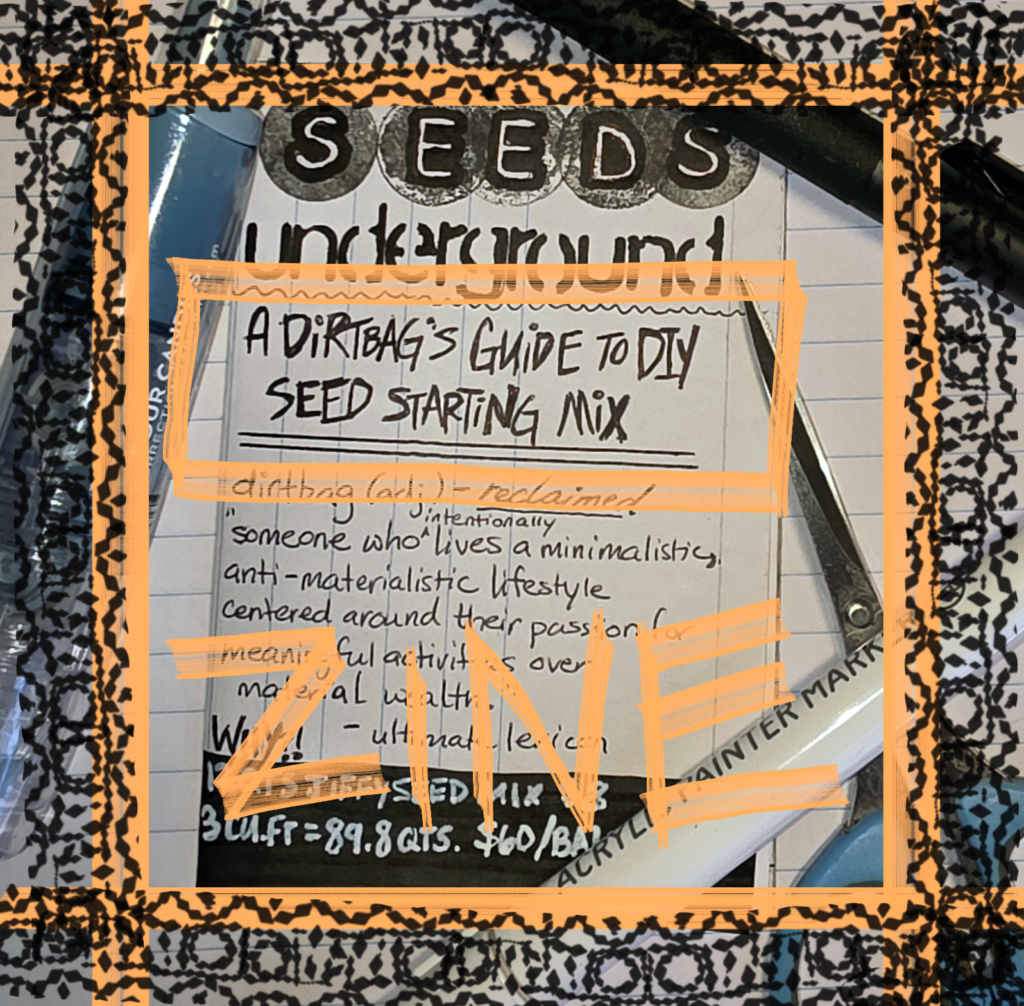
The second issue of SEEDS Underground, my little native gardening zine, is up! The feature in this one is “A Dirtbag’s Guide to DIY Seed Starting Mix.” Save, print, cut, fold and enjoy!
While I do have a more extensive post drafted like a cooking or baking blogger, I figured you’d want a simple version, too. A simple version in zine form is even better. This one you can stuff in your pocket and take it with you to shop for supplies.
Sterile doesn’t mean “sterilized.” If you need to sterilize your mix, there are ways to do it, but it’s totally unnecessary for most things. Like a true dirtbag, I don’t sterilize my pots, either.
Why might one need to sterilize soil? I’ve only ever done so for sowing ferns, and I do plan on making a fern sowing zine in the near future. The conditions for germinating and growing ferns are a bit too attractive to fungal pathogens, so it’s just safer to do so. For most of your garden needs, however, it’s overkill.
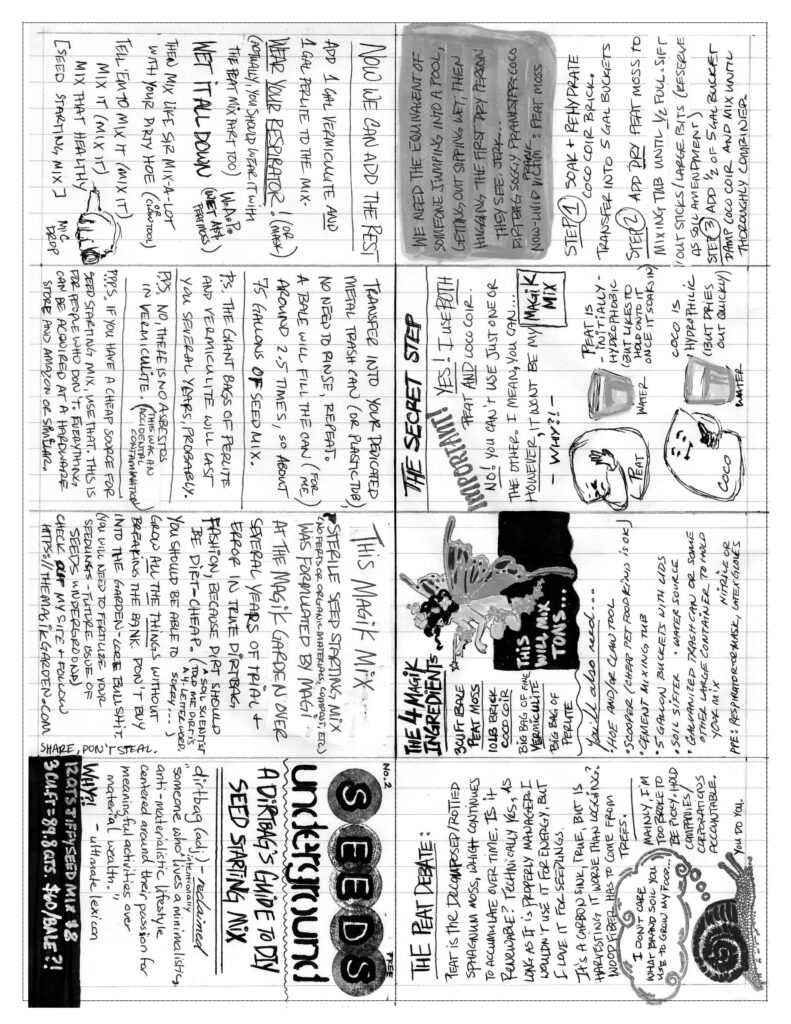
Here’s the zine! Download the PDF from this link, or save the image below. Keep scrolling if you’d like to get links to some of the products I use. If you need a reminder as to how to fold a zine, here’s a link.

A quick note on peat moss
There is a lot of debate that goes on in the horticulture industry from well-meaning individuals who claim that the harvesting of peat moss isn’t sustainable. There is good reason for concern. In Ireland, peat has been overharvested, where it is also utilized as their primary heat source. They also had far less of it starting out than we do. Sigh… I said in my zine I’m not going to get into this, but here we go.
I suspect this is largely part of the greenwashing that happens in the industry. There are companies who are competing for the market, and by doing so, they will cherry pick certain facts that meet their agenda. This, of course, goes back and forth. The peat industry is largely controlled by CSPMA, aka the Canadian Sphagnum Peat Moss Association (like a guild). There is one producer of sphagnum moss products based in the US that I personally like and recommend (Mosser Lee). Otherwise, we don’t have a huge share of the market (we import around 85%). Please do not buy sphagnum moss products if you don’t know where it is farmed – I have had seeds germinate in mine, and most I’ve seen on Amazon come from China.
On the other hand, we do have a large logging industry, so it’s no surprise that the alternative potting mix to peat moss is based off wood fiber products. With those facts, you start to see how the arguments fall apart. Yes, harvesting peat moss does release some carbon into the air, but why is the alternative to log trees that sequester it? They will give you some large number of how much peat moss is harvested annually (over 40k acres are harvested, which sounds like a lot), but they don’t give you the totality (it’s only .03% of total peatlands).
I think the biggest argument against it I’ve heard is that you can’t restore peatlands after harvest, not in our lifetimes, but this is an oversimplification. You can’t restore a mature forest after logging either, and while there is a way to log forests in a sustainable manner, we don’t do that here. We clear cut entire sections and then usually those are replanted with a monoculture of trees (usually pine or something that grows quickly) to be logged again.
But that doesn’t mean that peat isn’t a renewable resource – it absolutely is. Sphagnum moss is a living plant, and as it grows, the parts underneath decompose into peat. I actively grow my own live sphagnum moss for propagation of bog species, and it grows relatively quickly. You can start with a bag of it (I get mine here), fill several bins, and in a year’s time, that will at least double. Each time you can snip off parts of it and throw into another bin and it will keep growing, because it’s a relatively easy and quick-growing moss. You can’t restore a mature anything to its original condition after it is utilized, but again, the vast majority of bogs in Canada are left intact.
Put it another way, this line of thinking would have us believe that there’s no point in planting trees or meadows or anything on farmlands because you can’t restore it. Oh, that land was farmed, there’s no use in trying to rewild it, because it’s already ruined. That’s simply not true. Each year they only harvest about 3 inches of peat off the acreage they farm, and then the same acreage continues to be harvested for the next 20-40 years. After they reach a point, they stop harvesting, and allow the sphagnum moss and peat to reaccumulate. They rotate between the fields.
All this time, however, peat continues to accumulate in all of the other bogs that aren’t touched (there goes the carbon sequestration issue out the window). The amount harvested is far less than the amount accumulated each year. Sure, those particular acres may take thousands of years to regrow all the peat that was harvested, but we’re talking about .03%.
Here’s my final point. No matter what we do, we are going to be causing some harm or disturbance to something, somewhere. There is no such thing as a perfectly virtuous, harm-free life. The same argument goes to the use of herbicides to kill invasive species (I’ll touch on this in a future zine). We need to kill invasive plants to stop the spread of damage to our ecosystems. Some of them can only be removed with the help of herbicides. Herbicides are toxins. You need to eat, but much of our food is shipped back and forth – and the shipping industry pollutes. Even if you don’t eat meat, have you looked into the lives that are harmed by certain industries? The number of Orangutans murdered to farm palm oil? When PETA pushes their agenda against the wool industry (it’s just a haircut ffs), why don’t they talk about the microfibers from the acrylic sweaters they promote instead that pollute the oceans? Do you know how toxic the process is to produce “organic” cellulose materials like rayon (it’s much worse than glyphosate)? Have you looked into the mining industry to obtain the rare earth minerals for the device you’re using to read this post? When you shop for cheap clothes on Temu or Wish, do you consider the Uyghur genocide? Do you know the real reasons why some are drooling over Greenland and why we are helping Ukraine? Because I can tell you it’s not out of compassion… the government doesn’t spend money out of compassion.
Yes, it is depressing and, if you don’t take a break to step outside and breathe, at times even paralyzing to realize just how much harm is done to support our way of life. All of these things have been the source of my own existential crisis on multiple occasions. I very rarely buy new clothes – only thrifted, we do as much as possible to reduce or reuse any plastic, and we wear our cars and devices out. My own car is a 2011 model, and I only just upgraded my 2021 phone because there will be no more security updates starting February 2026. I’m typing on a PC I built in 2012, and my laptop was one that was getting tossed after Microsoft ended support for Windows 10 machines. I buy for life, reduce, repair, make do or do without. Sustainability isn’t something I do because it sounds good, it’s been my way of life for far longer than it’s been trendy. I was one of the kids picked for our school’s eco-conscious club when I was in middle school, and I got into architecture school partly based on an essay I wrote for my application ranting about the practice of clear-cutting and clearing lands for mass development. I could go on about this forever. And yet, for me, peat isn’t the hill to die on.
The amount of peat that you or I or anyone is going to use is a fraction of a fraction of a percentage of the totality harvested. However, if we’re using it to propagate native plants (that’s what I’m doing), the amount of good this will do for the ecosystem as a whole far outweighs the amount of harm that may come from harvesting. We can’t achieve perfect harmony. What we can do is make consciencious, informed decisions, and dig a little deeper (pun intended) when someone is trying really, really hard to sell us on some agenda. Who’s behind it, and why?
If my words aren’t enough, here’s an article that I think helps to explain it in greater depth.
(Mostly Affiliate) Shop Links
Get peat moss and the mixing tub at your local hardware center. They probably also have the galvanized trash can I mentioned, but the one I linked is around the same price from what I’ve seen. The links for everything else I mention in the zine are below. You can also look for these on other garden center supply sites. Buy whatever’s cheapest for you. PS. Amazon affiliate links don’t cost you any extra, it’s just a way for them to pay me for sharing a link to their site.
- Perlite: I’ve tried every brand out there, whatever’s cheapest. Currently looks like AeroSoil wins here.
- Vermiculite: I like a medium-fine granule for my mixes. This is what I’ve been using. This is also what I use to condition my seeds artificially.
- My recipe uses a 10lb coco coir brick, which will likely last you more than one bale. You can adjust and add more coco coir to the mix if it does. Something like this should be fine.
- You can use a regular mask though I’d highly recommend just investing in a proper respirator because you don’t want to mess around with dust. 3M is a trusted brand.
- A giant scoop like this one will make quick work of transferring your mixed potting medium to your container.
- I love using galvanized steel trash cans for all my potting soil needs. Any time I open a bag of potting mix, it goes in a can. It keeps stuff like weed seeds out of your mix, and it’s easily accessible. They should arguably also last much longer than plastic, but they’re also recyclable.
- Get the concrete mixing tub from the hardware store. The ones sold on Amazon are ridiculously priced. Shouldn’t be more than $8 for a medium sized one, or $17 for a large one.
If you’re a gardener you probably already have a wide variety of dirty hoes and soil claws at your disposal. However, I have to share this one – for which I’m not an affiliate. I just absolutely love the heirloom-quality tools made by Homestead Iron and dream of owning all of them someday. Since these days I mix my soil at table-height, I’ve switched to using “The Claw,” which I received as a gift from a family member. Use what you’ve got, but if you’re looking for a new tool and like to support small businesses, it’s worth it.
FTC Disclosure: Please note that some of the links in this post are affiliate or referral links (full disclosure here), and if you make a purchase or sign up for a service within a certain timeframe after clicking on one of those links, I may earn a small commission paid by the retailer at no extra cost to you. I wouldn’t recommend anything that I don’t or wouldn’t use myself. Thank you for your support!