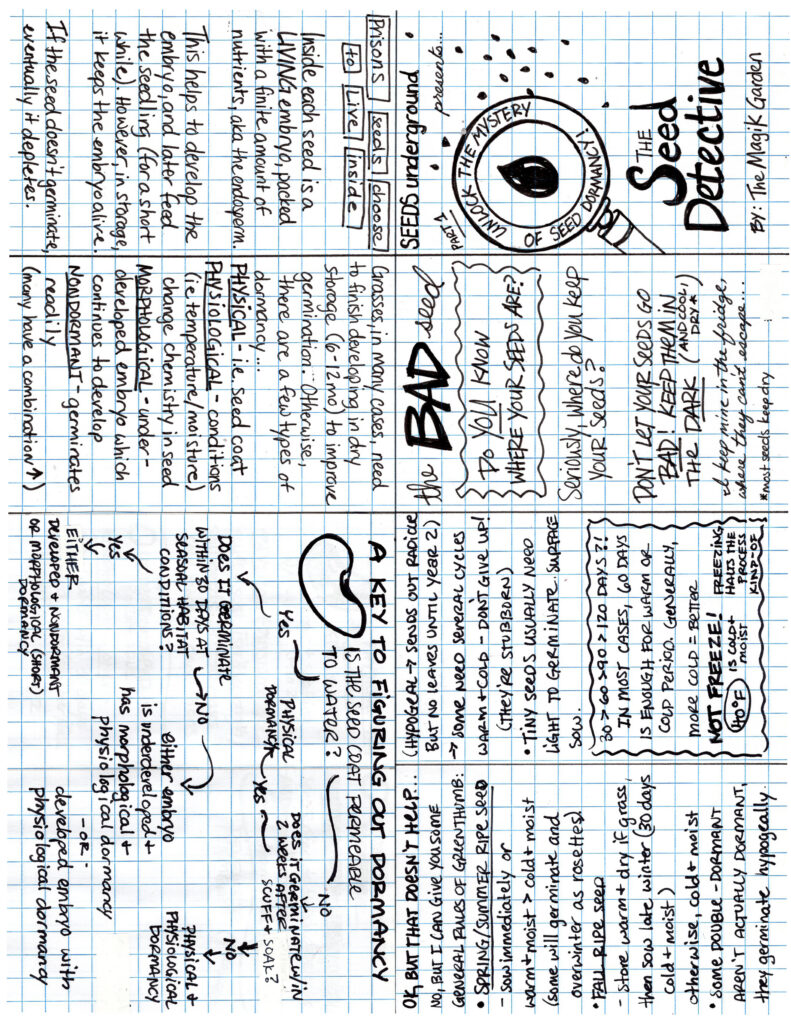
This is a mini spin-off from the usual Seeds Underground zines, which gets into the mystery of seed germination.
There are no codes here.
You can find germination codes pretty much anywhere that seeds are sold, or on sites like the Ontario Rock Garden & Hardy Plant Society Germination Guide. For most people, that’s all they need. In fact, most people don’t really seek to understand the why behind dormancy – it just is what it is.
Some people are really good at memorizing just that bit of information and it sticks. My memory doesn’t work that way. I have ADHD, and while many people think that means it’s a bad memory – it’s not any worse than most people’s in most cases. It’s just that the things I remember need to have relevance. Sometimes the only context needed is to write everything down (manually, not typing). When it comes to growing plants, I grow it to know it. I may know a plant species, but if I haven’t personally worked with it, I am not going to remember much about it. The experience of growing something is what provides the context for me to memorize it.
The same goes for memorizing germination codes. I don’t have them memorized. I couldn’t tell you how many days something needs. However, I can generally guess most of the time, if I know the species, what it will be. I’ll still double check, because you can’t be too confident with nature. Any time you get any sort of ego, she throws you a curveball. That being said, for the most part, you can usually figure out what a plant needs to germinate. It’s basically like figuring out a puzzle, or cracking a code, and the clue is in the species itself. For that reason, this is why this zine is called The Seed Detective.
That’s right, I’m going to explain the process of seed dormancy, and the why behind the warm moist and cold moist conditioning periods. Deno doesn’t like to use the word stratification, so I try to avoid it. Actually he doesn’t like the word dormancy, but since most other references continue to use this term, I’m going with that.
“These chilling periods are termed conditioning or conditioning periods. Traditionally they have been described as dormancy or breaking dormancy. These traditional terms imply inactivity when in fact certain processes are occurring at their maximum metabolic rate. The chilling period has also been described as stratification, an archaic term derived from the old English process of placing seeds in layers in sand and placing them outdoors overwinter. This term is equally misleading as are terms like vernalization or winterization. It is best to get to the heart of the matter and call these periods conditioning periods in the sense that they get the seeds into a condition where they can germinate.” – Norman Deno
I will also point out that this is an extremely simplified explanation. Unlocking the mystery of seed germination is an entire field of study. For our general purposes with the majority of seeds you will encounter when growing eastern native plants, the explanation in the zine provided are sufficient.
The last bit of advice, and what I generally suggest – instead of trying to understand and memorize codes, just sow them when they’re ripe, as nature intended. Leave them outside. If the seed’s good, it will germinate eventually. Instructions to folding the zine are here. Print to fit, trim off the margins making sure the central lines are in the middle, and it should fold up nicely for you. Click here for the PDF, or print the image below.