

The purple coneflowers that everyone’s been planting in their gardens are not native to the east coast. This species, Echinacea laevigata, is native. So why aren’t people planting this one instead?
The simple answer is because, until recently, it was listed as federally endangered. It’s recently been upgraded to threatened, but is still under federal protection. That means that the only way to obtain it is to find a local source within your state, or someone who offers seed. I have not found anyone selling the plants locally, and I only knew of one source for seed which understandably sold in very limited quantities, as I am also forced to do for the time being.
This is the unfortunate other side of federal protections of species. On the one hand, the intention is to discourage poaching and prevent destruction of remaining habitat. On the other hand, in my opinion, it ends up encouraging poaching—as someone I once knew would say, “locks are for the honest”—by restricting our ability to propagate and sell them to the general public. I am not the first person to say this. Norman C. Deno—a personal hero of mine—addressed the botanical community and USDA about this topic. He is very well known among growers as having produced what is considered one of the “bibles” of seed propagation. Before he came along, nobody had really sat down to document how to germinate the seeds of thousands of different species, let alone try to understand why they differ. At least, it wasn’t anyone who made this public knowledge.
The United States government and State governments have published lists of endangered species. It is illegal to distribute these plants or seeds of these plants. This policy and the laws designed to enforce this policy can only serve to speed up the extinction of the species by discouraging propagation. Further, many of the species on the present list are only minor variants of common species. The law can be easily circumvented by distributing the variant under the name of the species, particularly since the variants are marginally distinct, or by distributing under a new name since there is no final authority at present on names of species. It is felt that the laws should be more specifically directed towards preventing commercial collecting. The laws could also be rewritten to encourage propagation, especially by seed.
Two groups oppose propagation programs. One group places their forcebehind saving plants as if plants were static objects. In their view it becomes more important to save plants than to grow plants. In other words a plant saved is better than a plant grown. A second group has the view that raising large numbers from seed, introducing the species into new and suitable habitats, and other actions which promote and accelerate evolution are looked upon at best as causing taxonomic grief. This book takes the view that these oppositions to propagation are in error. Our society already propagates, manages, and distributes animals and fish with much success. Now we must manage plants the same way. This is the way to preserve endangered species and serve conservation, and most of all, to express our love of plants.
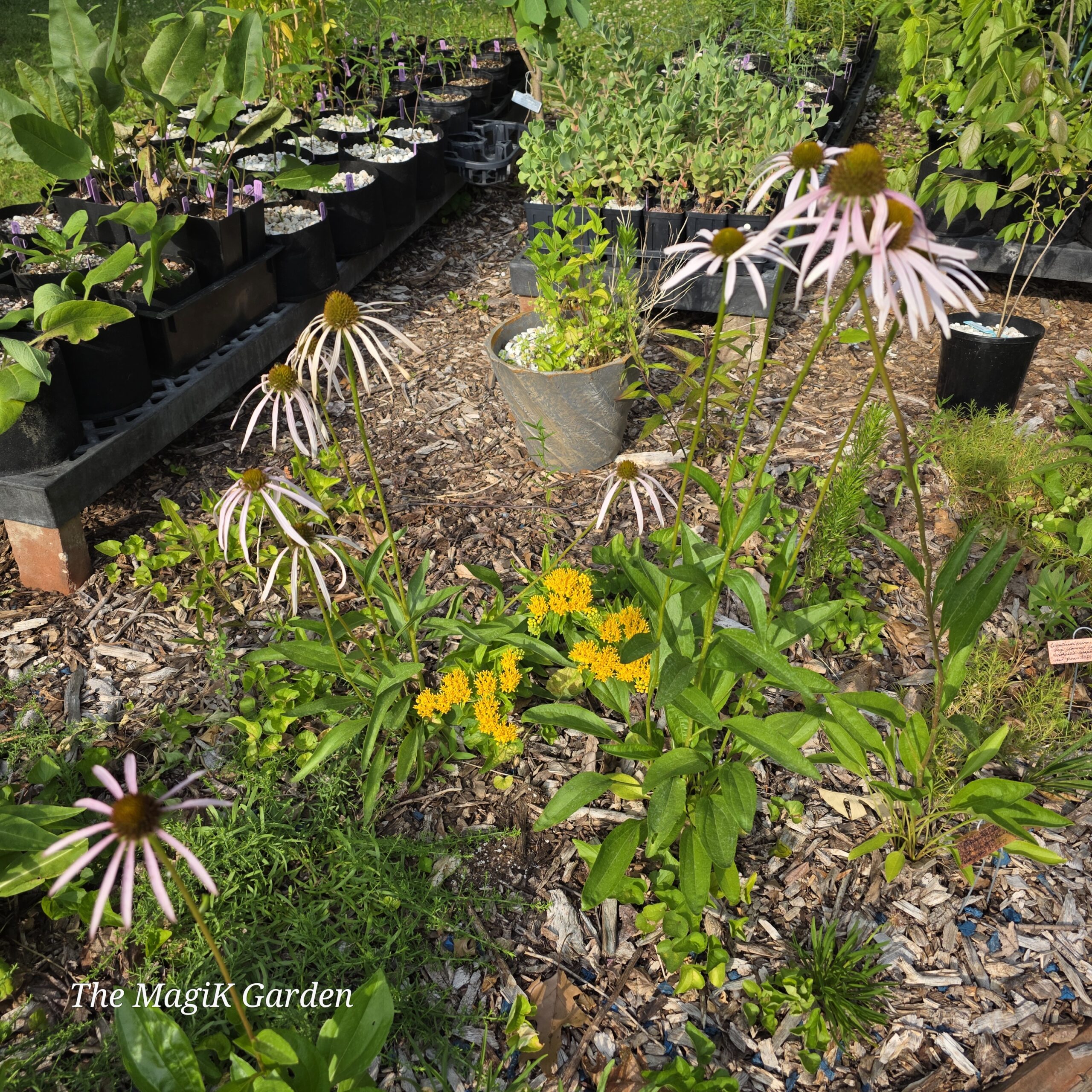
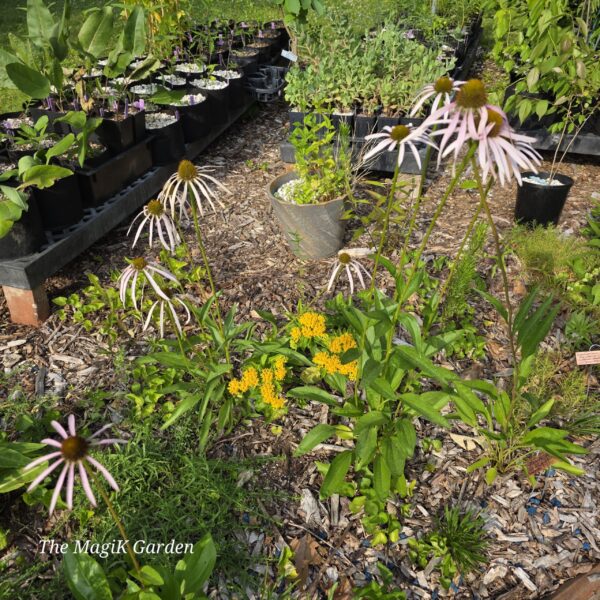
[Note: The emphasis on the first line about speeding up extinction is Dr Deno’s. The emphasis on the way to preserve endangered species is mine.] The way to circumvent the legality of distribution of seed is to include the disclaimer that the seed is from cultivated origin. This is absolutely true. I obtained seed from a source that cultivates the species. I then spent the last three years growing and cultivating them myself. 2026 is the first year I am able to offer the seed more widely. Either way, my plants are not collected from the wild. I grew them, planted them out in a suitable habitat, protected and nurtured them until they produced flowers, as you can see in the photo. They all exhibit the traits of smooth purple coneflowers: the leaves and stems are all smooth. I also removed any presence of other coneflower species from my garden before they flowered. This is important if the intention is to prevent hybridization, because they will hybridize. If you are growing them anywhere near other near-native species, then you risk cross-pollination. Normally this isn’t a huge issue; however when it comes to trying our best to revive a once-endangered-now-threatened locally native species, we do not want species that are not native to this region to hybridize with them. Especially since there’s always a chance some of this seed will get out into the wild and could also affect any wild extant populations, not that there are any known to be present in PA. Unfortunately, purple coneflower is now considered adventive and naturalized in much of PA (and for some reason, we have that species on our conservation license plate, not the federally protected smooth purple coneflower).
I am so excited to be able to offer this species, both as plants and seed (plants coming soon). It’s been a passion project of mine to at least participate in if not establishing a local grassroots effort to get native gardeners (and others) to help revive this species. I want to prove what Norman meant when he wrote “It is here that the amateur and professional grower can make a contribution.” In fact, it’s already been proven. The Tennessee coneflower Echinacea tennesseensis—now listed as G2—was also once on the brink of extinction until The Nature Conservancy, along with the state of Tennessee and US FWS cooperated to restore its populations. You can now purchase the seed from various seed sellers. Although it does fit my nursery’s focus on helping to restore endangered species and/or preserve the genetics even if cultivated, I don’t grow that one because I am entirely focused on our locally native species here. That one was once federally listed but was later removed due to their efforts. Another species which I do offer, the Georgia aster Symphyotrichum georgianum is not federally listed but was also a G2 species that has recently been upgraded to G3. This came about thanks to local efforts in Georgia to educate the public and get them involved in growing it in their gardens. What’s to say we can’t do that here?
I think the hardest part will be to convince native gardeners that if you are truly serious about conservation, it’s time to set your personal feelings aside when it comes to how much you love the other species of purple coneflowers and realize that keeping them may do more harm than good. Yes, it does show benefit to pollinators. Yes, it also functions as a host plant. However, now it’s time to focus on the plant itself that needs saving.
What about the colors?? As it turns out, thanks to growing mine from seed, there does appear to be a good deal of color variation. One of the plants I grew ended up with white flowers. Others, as you can see in the photo, show a pale pink. If you end up with some that have white flowers, do not panic. When it comes to keying out species, the colors themselves are mostly irrelevant due to variability.
Germination instructions
While it is possible to germinate some of these without any treatment whatsoever, I would recommend at least 30 days of cold & moist conditioning. Better yet, sow them outdoors anytime from fall through winter so they are exposed to fluctuating seasonal temperatures and conditions. There’s a possibility that some of the seed will not germinate this year (or ever) so you will have more than the minimum listed to increase your chances of getting at least something. In my case, some years are better than others. I intended to offer the plants this year, but the germination was very low. This year all of my plants were in full bloom, so the likelihood of successful pollination increased.
Cover very lightly. I like to poke mine in pointy tip down so that the flat end is level with the soil surface when sowing. This way there is good contact with the soil but there is also some exposure to light.
These are not tested for germination. The test requires sending in at minimum 400 seeds (ideally 1000) which are destroyed in the process. I am including this disclaimer so you know that it may take some time for you to get a decent flowering patch established when trying to grow them from seed yourself. Add to that the problem with climate change along with prolonged, erratic germination, and it’s going to take time. Don’t dump out your seed flat until the end of the 2nd year. All I can promise is that it is well worth the wait and the effort.
seed packet & growing information
You will receive at least 25 seeds. There will be more than that in the envelope. Limit 1 packet per person. I want to make sure that as many people can grow this as possible if they want. If I had a lot of extra seed to sell in bulk or in greater quantities, I would offer it. If I have extra seed left over end of winter, I will lift the restriction. Please don’t put through more than one order to bypass the limit – I will not approve it.
The seed was collected from my own cultivated plants in my garden in Blue Bell, PA. The original provenance is unknown. They are open pollinated, and although I removed the presence of any/all Echinacea purpurea that I had growing in my own garden, there’s always a risk that someone else has them growing and they could hybridize. Pay attention to whether or not your seedlings/plants have smooth or hairy leaves. Yank the hairy ones out.
These plants do best in full sun in consistently moist soil. They may survive in part sun, but they will not thrive, let alone bloom. That’s part of why they’re disappearing in the wild. Habitat degradation isn’t just the result of development, but also succession. They do not do well being shaded out and need at minimum 6 hours of sunlight. They are fairly drought tolerant once established, though I keep my beds mulched.
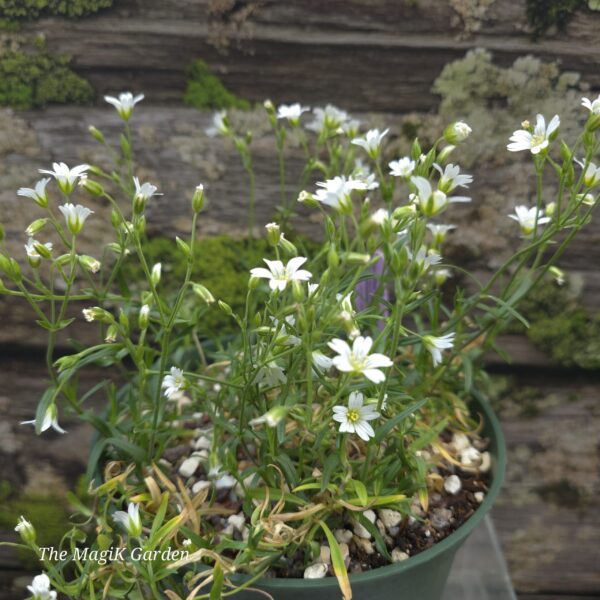
Because they are smooth, the herbivores will eat them. Protect them under cages or stay on top of spraying with a deer deterrent. Better yet, you can also protect them by surrounding them with fragrant, herbaceous, low growing species like Pycnanthemum spp. Once established they hold their own against encroaching roots and are unlikely to be crowded out. My favorite garden pairs include Cerastium arvense (nursery plants; nursery seed) as well as ‘Snow Flurry’ aster (which I don’t offer). I utilize a variety of herbivore deterrents, including DeerOut, Rabbit & Groundhog Out, which have remained reliable deterrents for me for several years at this point.
Reviews
There are no reviews yet.