




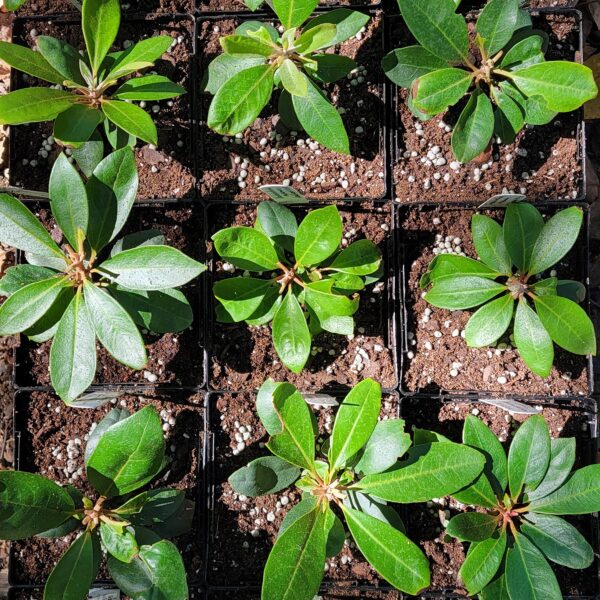
Expected availability: spring 2026
This native azalea is endemic to upper coastal plain areas of southern Alabama and western Georgia, and one of the most recent additions to our list of native species. The story of how it was even discovered, let alone proven to be a newly described species, is a bit of a wild ride. If it weren’t for advances in technology that made DNA sequencing and flow cytometry possible, taxonomists would have likely continued to identify this as a completely different species. What’s even more wild is the fact that the species it was misidentified as for the longest time isn’t even that closely related to it. They just looked similar enough, but their genes told a different story.
Recreate the habitat
Quoting the text linked above, which is an excellent resource for learning clues about this native tetraploid azalea:
From a behavioral point of view, Red Hills azalea seemed unusually distinct, and its locations were downright predictable. In an area underlain by the proper geology, look along the base a steep north-facing slope above a stream or on a high sandy-ridged flat or bank along a waterway; and if there are other ericaceous plants nearby, Red Hills azaleas are likely to appear – if not there, then 200 yards in either direction through the brush and the snakes and the smilax. No permanent water nearby, no plants.
Sources seem to agree that slightly acidic, sandy, moist but well-drained slopes are the key to keeping it happy. It is currently not listed as native outside of its endemic range, something that could potentially change if other populations are discovered, but I do know it is at least hardy to 6b/7a.
Should you fertilize?
It would be advisable to amend your soil if all you’re working with is clay, and plant it on a berm in part sun (AM sun is okay, PM sun would scorch the leaves) to light shade. It does thrive in high humidity, so our east coast humid summers should pose no issue whatsoever, helping to make it feel at home. Consider testing your soil and, if necessary, applying a soil acidifier at scheduled intervals if necessary – it is reported to tolerate a range between 4.5 and 6 pH.
To prune or not to prune
Remove deadwood, damaged or broken branches as needed. It generally is not known to need heavy pruning, but any shaping can be done before new growth resumes in late winter to early spring. It’s also a good idea to check periodically for pests that typically are known to go after azaleas, especially deciduous azaleas, such as aphids, mealybugs, lace bugs and spider mites. A healthy shrub that isn’t over-crowded tends to fare better than one that is stressed.
That lemony-fresh scent
Most people do not associate azaleas with fragrance, especially when they only azaleas they’re familiar with are the numerous hybrids of this extensively cultivated species. However, there are a number of native azaleas that are fragrant, including the Red Hills azalea, which those who know it claim that the large, honeysuckle-like blooms smell like lemons.








Reviews
There are no reviews yet.