

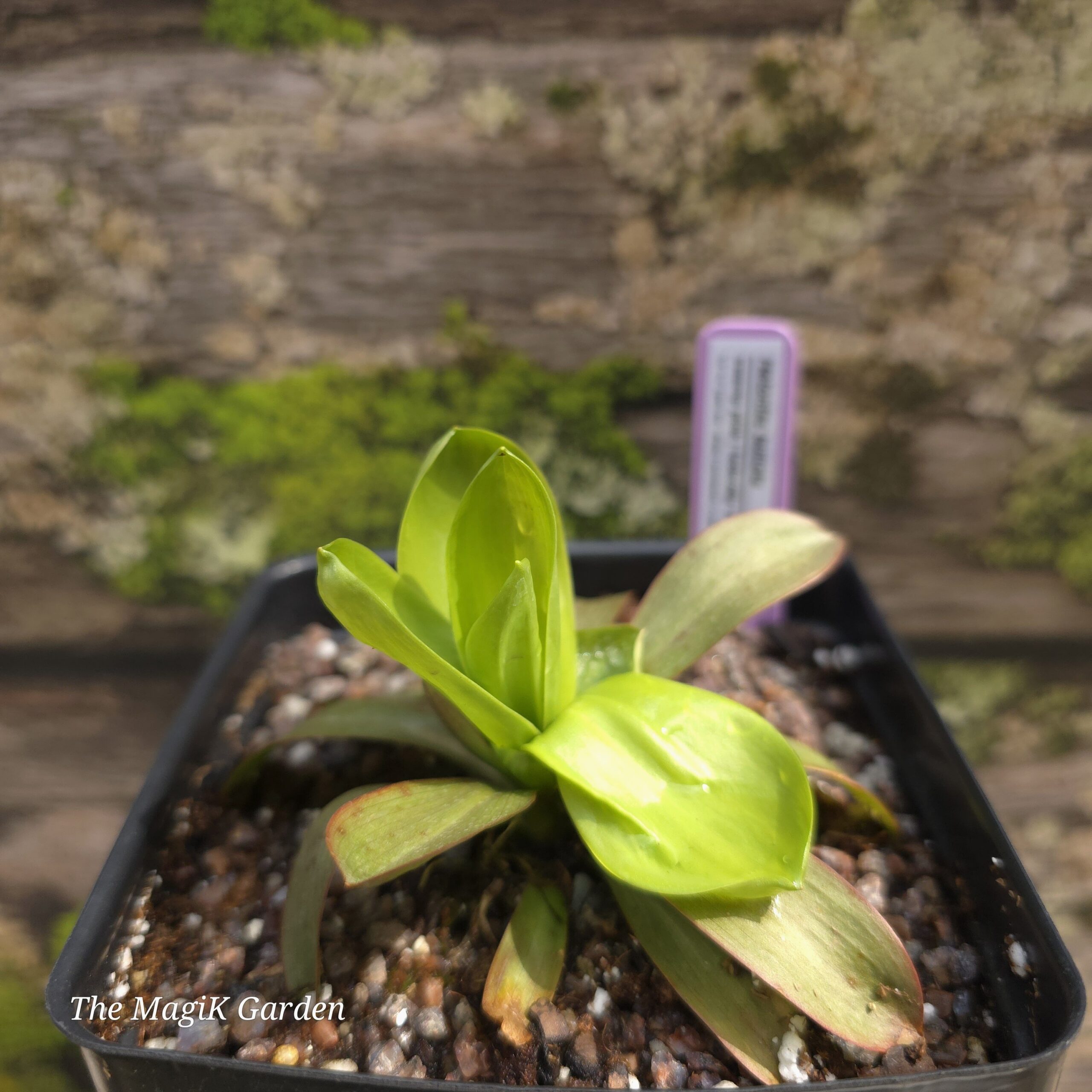
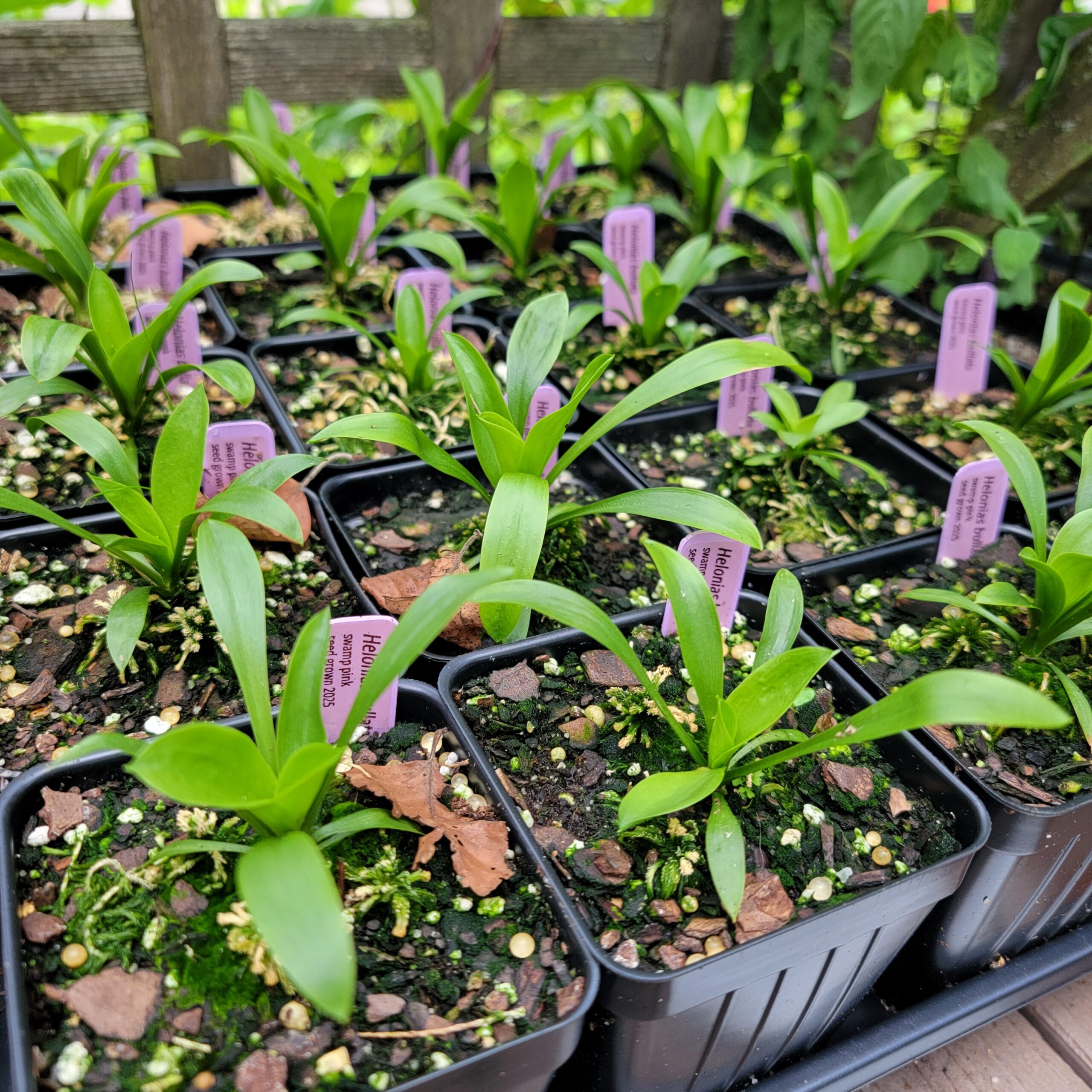

The sale of swamp pinks is limited to no more than two per customer. This is to prevent someone from buying them up and reselling at a hefty mark-up, while ensuring that everyone who wants them gets to try growing them. If you add more than two to your order, I will remove them during the approval process.
The practice of marking up hard-to-find plants for profit encourages poaching from the wild. If I sell out and there continues to be demand for them, I can always grow more. My plants are responsibly cultivated from seed, never poached from the wild.
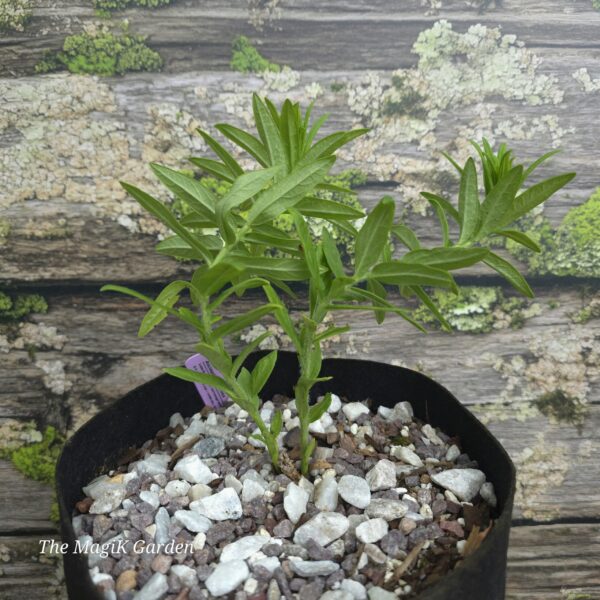
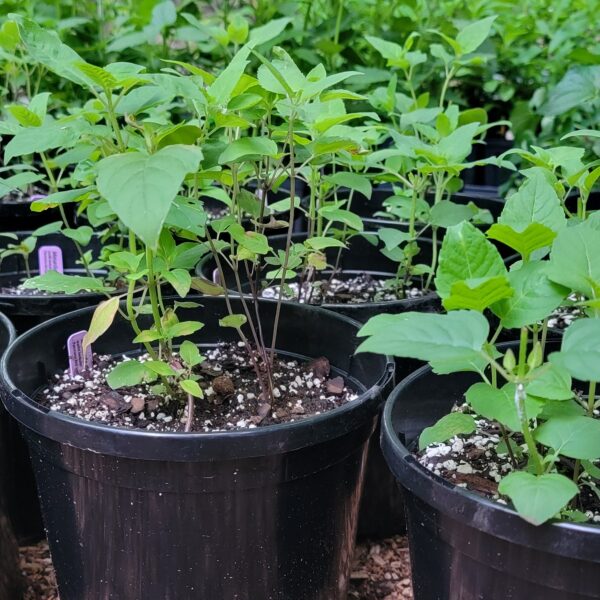
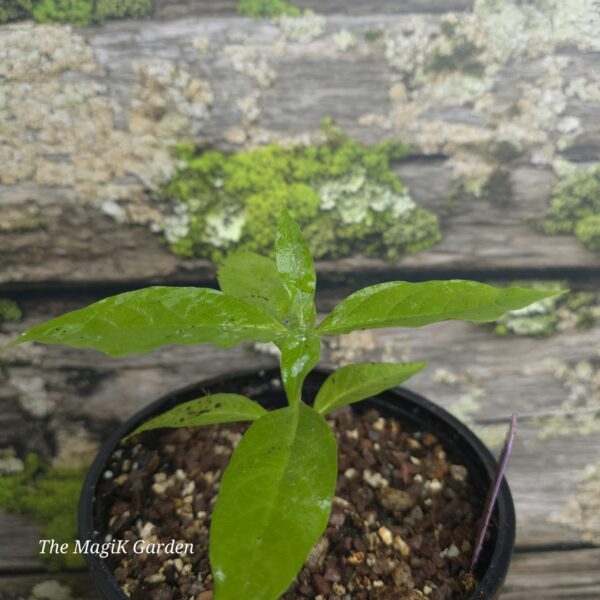
The lovely swamp pink… I honestly don’t know why it’s so rare in cultivation. It’s hardly difficult to grow from seed. And they’re just as easy to keep happy in pots. This one is near and dear to my heart. It’s the first species of concern I went through the effort of hunting down seed, researching to the fullest extent, and cared for like they’re my own children. And I was successful at it.
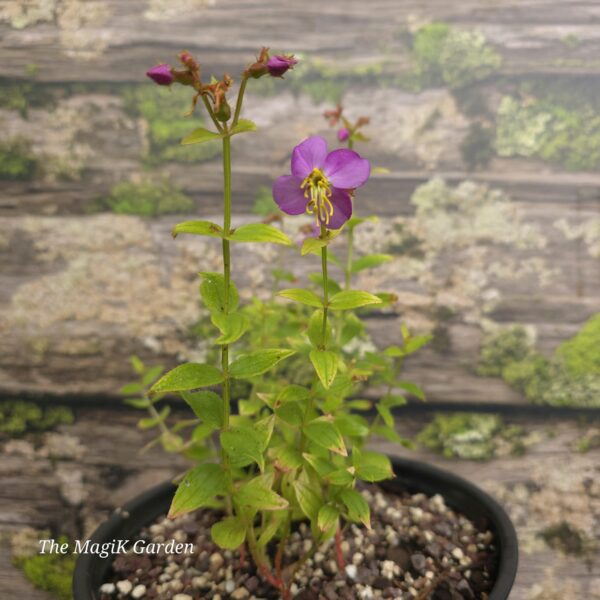
Why did I focus on this one? The common name jumped out at me while I was looking it up on bplant’s list for the Northern Piedmont ecoregion’s natives. Swamp pink is such an odd name. I saw the photos and fell in love with it, and wanted to grow it here. The flowers, which bloom in early spring, are a bright pink with blue anthers. Truly, our wetlands have some of the most unusual and spectacular species that exist on this planet.
A friend and mentor of mine wished me good luck on finding it due to it being federally threatened. I said fine, I’ll grow it myself. That’s exactly what I did, and why I have some now to share with you.
Find swamp pink in the wild
Highly unlikely you do, unless it’s on private property or you have access to protected sites. Due to the rarity of this species, the locations are kept secret from the public. These are not native to Pennsylvania, however they are a species that grow in the Northern Piedmont. I am highlighting key phrases in the bottom quote that should clue you in on how to best site your plant.
Considered an obligate wetland species, swamp pink occurs in a variety of palustrine forested and scrub/shrub wetlands in New Jersey including: forested wetlands bordering meandering streamlets, headwater, wetlands, sphagnous Atlantic white cedar swamps, and spring seepage areas. Specific hydrologic requirements of swamp pink limit its occurrence to wetlands that are perennially saturated, but not inundated by floodwater. The water table must be at or near the surface, fluctuating only slightly during spring and summer months.
Swamp pink is a shade-tolerant plant that occurs in wetlands with varying canopy closure. Plant species associated with swamp pink include: Atlantic white cedar (Chamaecyparis thyoides), red maple (Acer rubrum), pitch pine (Pinus rigida), American larch (Larix laricina), black spruce (Picea mariana), red spruce (Picea rubens), sweet pepperbush (Clethra alnifolia), sweetbay magnolia (Magnolia virginiana), sphagnum mosses (Sphagnum spp.), cinnamon fern (Osmunda cinnamonea), skunk cabbage (Symplocarpus foetidus), and laurels (Kalmia spp.). Swamp pink often grows on hummocks formed by trees, shrubs, and sphagnum mosses, which indicates that these microtopographic conditions may be an important component of swamp pink habitat. (Source)
Additional resources and a general map of current populations can be seen here.
Grow swamp pink in your garden
I’m certainly not an expert, but I also tend to look at lots of photos and read as many reports on habitat as I possibly can, and then plant based on intuition. I knew they tolerated shade, because some of the photos I’d seen were of populations growing in bottomland ditches in forested areas. Would a moist mossy shade garden be considered a wetland? Maybe bottomland… but the key word is that they grow in hummocks. The crown needs to be well-drained. I did accidentally kill a couple due to crown rot last winter. Those were still in pots, but in a heavy mix assuming they liked being wet. They didn’t make it. The ones I planted on raised mossy spots in the garden were just fine. End of summer 2025 – they’re still chugging along, slowly.
The only thing I haven’t tried doing is moving them from one spot in the garden to another, because I haven’t needed to. Reports also indicate that they do not handle transplanting well. My guess is that in the ground, they develop incredibly long roots. The ones in the pots certainly do. This is to reach the water table where they are able to receive consistent moisture. Otherwise the roots are quite thick and fleshy, and not nearly as thin and fragile as other species I’ve worked with. Wherever they go in the garden, there needs to be a low water table or you need to find some way to keep their roots wet (a self-watering planter would work). Dappled light locations will be less prone to drying out than full sun.
You will want to protect them from herbivory. Everyone who knows this plant warned me of this – deer will absolutely browse this, and possibly rabbits as well. They’re also slow to grow. In the shade they won’t grow as quickly – the only reason I plant them here is it provides some insurance against drying out. Also, the other plants make it much harder for the deer to spot them, especially since they’re still small. If you have a pond, try creating a hummock in the middle of it (inside the liner so the base has access to water), or build a floating island. If deer have no problem walking through your pond, consider caging these just to be safe. For the first several years, the dollar store wire mesh waste baskets make excellent anti-herbivory garden cloches, and can be pinned down by garden staples. If you need to protect something larger and are lucky to get your hands on one or more, I love old crab pots and traps (I have one over a tiny Zenobia pulverulenta – they don’t seem interested in my larger one).
Whatever your growing experiences are with this plant, please feel free to share them with me. Like I said, this is not common in cultivation. It’s also Federally threatened, which makes it harder to obtain plants and seeds. I’m hoping we can help to change that, making it more available. The more we share information, the easier it will be for others to cultivate this in their own gardens.
Maintenance requirements
I don’t think this species is that difficult to grow. None of the ones I’d planted in the garden have died on me, and I generally don’t need to worry about them, but those are all in dappled shade. I will periodically check on them to see how they’re doing. Don’t let the crown sit in water, and don’t let it dry out. It’s prefers a similar habitat to Lobelia cardinalis. A few of the ones I grew this year I’m planting in a part-full sun bed where I have common rush, a variety of lobelias, Persicaria pensylvania that seems happy re-seeding in its original location, marsh rattlebox, halberd-leaved hibiscus and bunchflower (added this year) growing. A few others will be going in a bed in my seepage where I have my irises, sheep laurel, marsh marigold and recently added bog milkweed. If this ends up being true, and they take off, that will be a huge help to gardeners in the future. All in the name of science.
Right now, the only non-wetland site I can recommend with any confidence is a mossy mound in part sun to shade (where the moss never dries out). It doesn’t have to be sphagnum moss. Even the damp shady inside corner of your yard against the house would work – as long as you mound up the soil a bit and it isn’t getting pounded with rain in a downpour.
If your soil tends to remain moist already, keeping it well mulched with arborist chips keeps it soggy. That aforementioned lobelia/hibiscus bed I mentioned used to be turf lawn. However, I noticed that it would pond during heavy rains, and after dumping a load of wood chips on it, it’s now permanently soggy underneath. Where the plants sit at mulch-height, the crowns are dry. Sometimes, that’s all it takes.
Arborist chips add organic matter (if you have room to store a chip dump, leave it sit for a year or two, then dig under it for the good stuff). Something to note about hummocks – they start out as fallen logs/stumps or dead shrubs which then get covered with moss. That means it is rich in organic matter. Leaf mold would also be an excellent amendment here. If you have not started on your own leaf mold pile, you need one. If you’re especially good at letting things go for a long time like myself, a 10-year-old rotted log pile is hiding a goldmine underneath of the richest soil amendment nature invented.
A note on winter care…
Other than the fact that you should be caging these (and at this small size, a dollar store wire basket staked to the ground is sufficient), do not allow leaves to cover the plant in the fall. The foliage is evergreen. Leaf cover would shade it out too much in winter and provide conditions for the plants to rot. In forested wetlands, if growing on hummocks, the leaves would blow off and around the mounds. Bogs really don’t have a problem with leaf litter. The only trees that are found growing in bogs are ones with fine needle foliage. Ideally, you should not have leaves covering mossy areas either, because moss is also evergreen. Anything that is evergreen needs continued access to light for photosynthesis.
Judgy Judy says…
Judgy Judy can fudge off on this one. Her opinion one way or another doesn’t matter. We’re trying to preserve a species here. (She probably wouldn’t care, this isn’t exactly a weedy plant if you catch my drift.)


Reviews
There are no reviews yet.